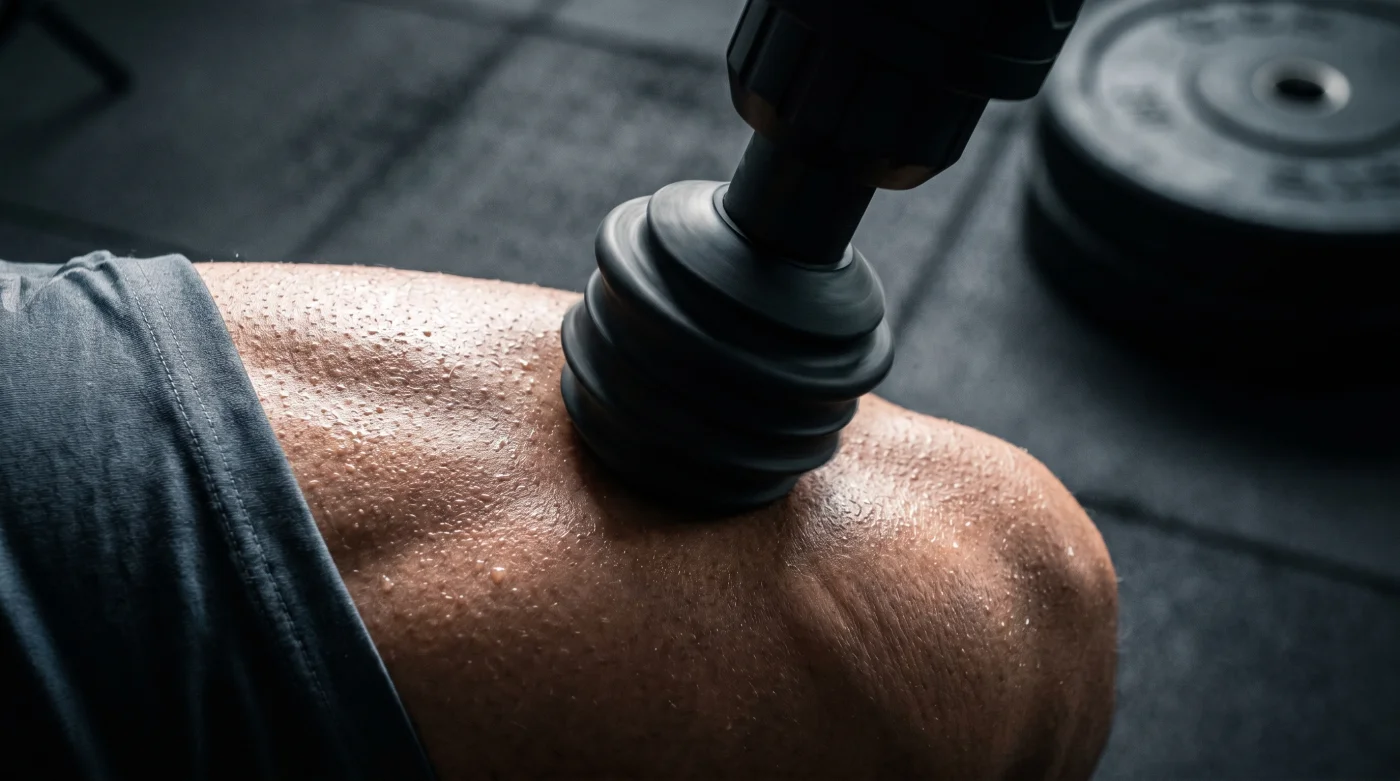
Imagine sitting on the edge of the couch after a ten-mile Sunday run. The house is quiet, save for the low, rhythmic thumping of a massage gun against your quad. You trace the foam head over tired muscles, expecting the vibration to magically melt away the tightness. It feels good, like scratching a deep itch, but by Tuesday morning, the stiffness always returns.
Most of us treat recovery tools like magic wands. We lie flat on our backs, completely limp, letting the machine do all the heavy lifting. We expect passive healing, assuming that simply rattling our tissue at high speeds will somehow rewrite the damage of a hard workout.
But professional locker rooms look entirely different. If you walked into a recovery suite after a major game, you wouldn’t see athletes lying still. You would see them moving, stretching, and pushing against the percussion. They know a fundamental truth about human tissue: a massage gun is utterly useless if your muscle is asleep.
The Dough Metaphor: Why Passive Pressure Fails
Think of your muscle fascia like a thick slab of cold dough. If you take a rolling pin and just vibrate it on top of the dough, nothing happens. The surface jiggles, but the structural density remains completely unchanged.
To actually stretch and smooth that dough, you have to pull it. You have to apply tension. When you passively run a massage gun over a relaxed muscle, the percussion just bounces off the surface layers. The fascial web, which traps all that stiff, lingering lactic acid, refuses to open up.
By actively flexing or stretching the muscle while applying the massage gun, you pull the dough taut. Suddenly, the vibration penetrates the deeper layers, separating sticky tissues and clearing out cellular waste in a fraction of the time. What you thought was a tool for relaxation is actually a mechanism for forced extension.
Consider Marcus Thorne, a 34-year-old physical therapist who manages recovery for a roster of minor-league baseball pitchers. For years, his athletes complained of dead arms despite hours with percussive devices. Marcus changed one rule in his clinic: no massage guns on a flat table. He forced his pitchers to slowly mimic their throwing motion against a resistance band while he applied the percussion. Within two weeks, the persistent shoulder stiffness disappeared entirely. The active tension was the missing ingredient.
Adapting the Method to Your Sport
Not every muscle needs the exact same protocol. How you apply active tension depends entirely on the mechanics of your weekend obsession.
- Knee Braces Surge As Turf Injuries Plague Professional Leagues
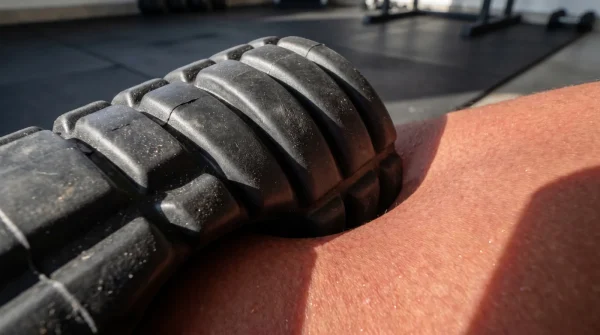
- Foam Rollers Worsen Knee Band Inflammation When Used Horizontally
- Electrolyte Powders Waste Money Without Precise Sodium Potassium Ratios
- Playbook Wristbands Simplify Complex Audible Chains For Amateur Quarterbacks
- Pine Tar Sticks Around Because Batters Hate Synthetic Grips
For the Pavement Pounder
Runners usually suffer from glued-up calves and locked hip flexors. Instead of sitting on the floor to hammer your calves, stand up. Place the ball of your foot on a stair edge. As you run the massage gun down your calf, slowly drop your heel toward the floor, forcing the muscle into a deep stretch while the machine works.
For the Iron Enthusiast
If you spend your mornings moving heavy barbells, your lats and chest are likely thick with adhesions. Hang from a pull-up bar with one arm, letting your body weight pull the lat taut, while a partner applies the gun to the stretched tissue. The release is instantaneous, bypassing the usual days of delayed onset soreness.
For the Desk-Bound Competitor
Maybe your biggest athletic hurdle is surviving eight hours in an office chair before hitting a rec-league basketball game. Your glutes are asleep. Lie on your back, bend your knee, and pull it toward your chest. Run the gun over your glute and hamstring tie-in while actively pushing your knee against your hands.
The Active Percussion Protocol
Bringing this into your living room requires a shift in your recovery mindset. You have to stop treating recovery like a nap and start treating it like a low-grade workout.
Start by identifying the tightest band of tissue. Do not turn the gun on its highest setting; keep it on a low, steady frequency.
Next, move the muscle into its fully shortened position. Apply the percussion pad directly to the belly of the muscle, applying firm but manageable physical pressure.
Now, over a slow four-second count, lengthen the muscle. Breathe through the tension, moving smoothly until you reach a full stretch.
- Pin the tissue: Find the stiffest spot and hold the gun there.
- Shorten and lengthen: Move the joint back and forth five times.
- Sweep the length: Glide the gun from the attachment point to the center while holding the stretch.
- Flush the waste: Finish with broad, sweeping strokes toward your heart to move the cleared fluids.
The Tactical Toolkit: Keep the gun at a 45-degree angle, not straight down. Use a flat or dampener head attachment for active stretching, avoiding the hard plastic bullet which can bruise taut muscle. Spend no more than two minutes per muscle group.
Redefining Your Recovery Window
When you stop treating your body like a broken machine waiting to be fixed, everything changes. Moving away from passive recovery forces you to actually listen to your tissue. You stop mindlessly numbing the soreness and start actively participating in your own repair.
You will notice the difference the next time you step onto the court, the trail, or the gym floor. Your joints will glide a little easier. The heavy, sluggish feeling that usually haunts your first mile will vanish.
Mastering this simple physical truth gives you back your weekends. It turns a frustrating cycle of chronic tightness into a predictable, manageable process. You are no longer just waiting to heal; you are actively clearing the path for better movement.
“A massage gun without muscle tension is just an expensive way to shake your skin.”
| Key Point | Detail | Added Value for the Reader |
|---|---|---|
| Passive Percussion | Using the device on relaxed, limp muscles. | Provides temporary surface relief but fails to reach deep fascia. |
| Active Tension | Stretching the muscle while applying the massage gun. | Clears lactic acid faster and restores full range of motion. |
| Angle of Application | Holding the gun at a 45-degree angle. | Prevents bone bruising and encourages fluid flush toward the heart. |
FAQ: Mastering Active Recovery
Why does my muscle stiffness return so quickly after using a massage gun?
If you use it passively, you are only stimulating the surface layer of your skin and muscle. The deeper fascial adhesions remain locked.
Do I need to turn the speed all the way up for better results?
No. High speeds can cause the muscle to tense up defensively. A lower speed combined with a slow stretch is far more effective.
How long should I spend on one muscle group?
Two minutes is the maximum. Beyond that, you risk irritating the tissue and causing inflammation rather than clearing it.
Can I use active tension on a strained muscle?
Avoid direct percussion on acute strains. Work the surrounding muscles to relieve pull on the injured area without causing further damage.
Which attachment is best for the stretch method?
The flat head or the dampener. They distribute pressure evenly as the muscle shape changes during the stretch.