The Friday night air smells like bruised turf and damp athletic tape. You settle your cleats into the dirt, feeling the familiar, hollow thud of your heart against your ribs. Across the line of scrimmage, the middle linebacker taps his thigh pad, subtly leaning his weight toward the strong side. The play clock glows an aggressive red, ticking down from ten. This is the exact fraction of a second where games are either taken over or entirely given away.
Instead of feeling the rhythm of the defense, your mind is busy flipping through mental binders. You are trying to recall the weak-side dig route variation of a play call you heard thirty seconds ago. The safety creeps up, but your processing speed is bogged down by rote memorization. You are translating terminology instead of playing football.
Amateur quarterbacks often carry the heavy assumption that mastery means internalizing a massive, sprawling passing tree. You force yourself to become a walking encyclopedia of offensive schematics, assuming that pulling a concept purely from memory proves your command of the huddle and your toughness in the pocket.
But the reality of the pocket tells a different story. Memorization delays processing speed at the line. When you rely solely on your mental archives to adjust an audible chain, you steal valuable cognitive bandwidth from the only thing that actually matters in those final three seconds: reading the physical reality of the defensive shift.
The Processor Overhaul
Think of your attention span like a computer’s short-term memory. If your internal RAM is maxed out trying to remember whether a specific play call requires the tight end to stem inside or outside against a Cover 2 shell, the entire operating system drags. You cannot react to the physical threat of the blitz because you are trapped in the theoretical design of the playbook.
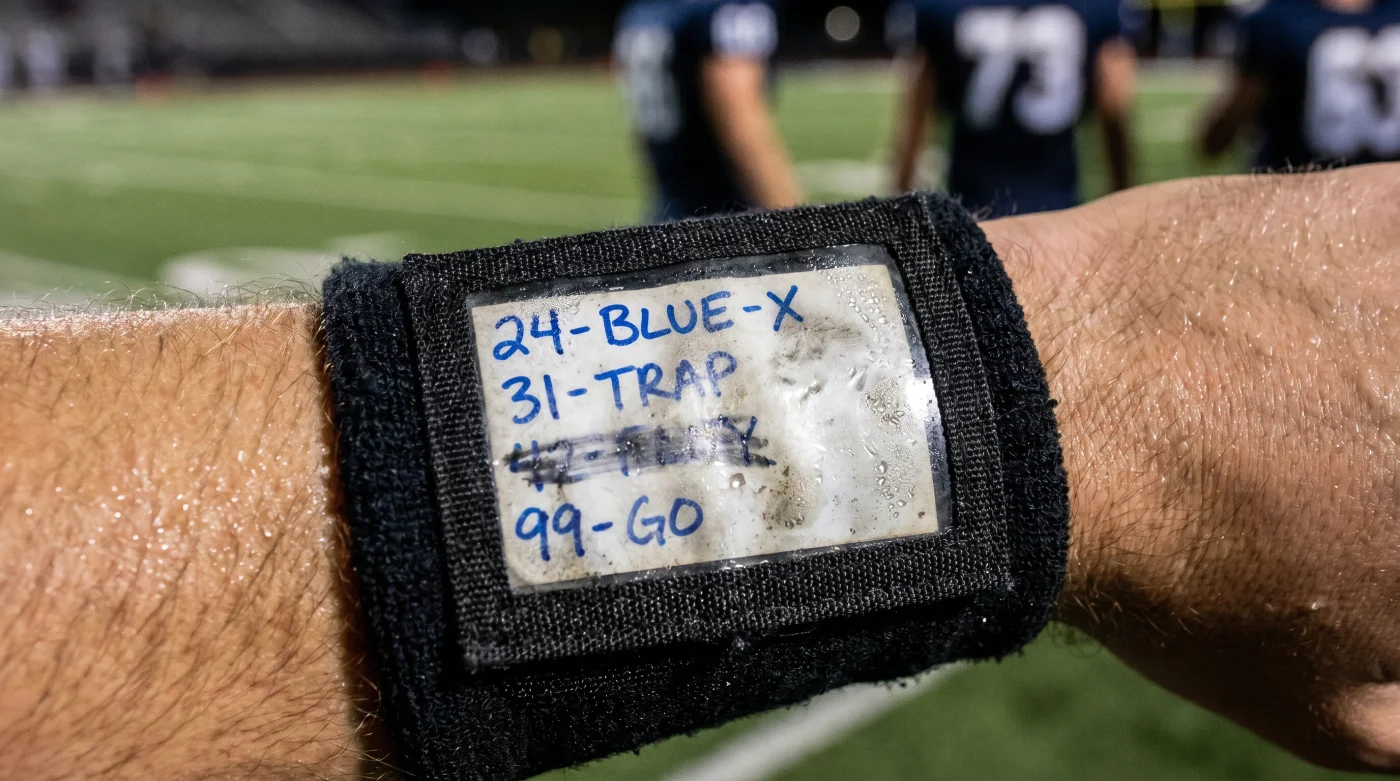
This is where the playbook wristband flips from a perceived crutch into a tactical processing weapon. When you map complex audible chains to condensed numerical codes on your forearm, you are offloading the heavy lifting of recall. The play is safe on your wrist, allowing your eyes and instincts to stay fixed on the shifting secondary. You stop thinking about what to do, and start seeing what the defense is giving you.
Consider Marcus Thorne, a 28-year-old quarterback coach in Ohio who builds offensive frameworks for regional champions. For years, he watched his smartest athletes freeze under pressure, taking unnecessary sacks because they were trying to remember the third option on a read-progression. He noticed that during quiet film sessions, his quarterbacks could recite the passing tree flawlessly. But on the grass, surrounded by defensive linemen and stadium noise, the cognitive load was simply too heavy. Thorne stopped forcing them to study flashcards and instead handed them a three-column plastic sleeve. He realized that a simple numerical system let his players stop acting like librarians and start playing like predators.
Structuring the Sleeve
Not all offensive rhythms demand the same architecture. How you organize your wristband dictates how quickly you can communicate the shift to your teammates. The goal is to shrink a paragraph of terminology into a single, punchy syllable.
For the Up-Tempo Specialist
If your offense relies on wearing down the defensive line with a no-huddle pace, your wristband needs to prioritize color-and-number grids. You look to the sideline, see a red board and the number four, glance at your wrist for the corresponding cell, and shout the code. The translation is instantaneous, forcing the defense to scramble to align while you hold the tempo advantage.
For the Heavy-Package Strategist
Maybe you run a pro-style system, heavy on tight ends and pre-snap motion. Your audible chains are longer, requiring detailed shifts in blocking assignments. Your wristband should group concepts by defensive fronts rather than raw tempo. You keep a column dedicated entirely to beating zero-coverage blitzes, giving you a localized panic button that requires almost zero translation time when the linebackers show pressure.
Coding the Snap
Building an effective wristband is an exercise in ruthless editing. You do not print the entire playbook. You print the answers to the test.
To build a system that forces quicker defensive reading, you have to strip away the noise. You reduce the terminology to absolute basics, grouping your most reliable audible chains into numerical sequences that are easy to bark out over a noisy crowd.
- Divide the paper insert into three distinct columns, color-coded by down and distance.
- Assign a two-digit number to your base play and a three-digit number for the immediate audible counter.
- Format the text using a heavy, sans-serif font, sizing it to 12-point or larger so your eyes can snap to it without squinting.
- Laminate the insert with a matte finish to prevent the stadium lights from creating a blinding glare on the plastic window.
The Tactical Toolkit for this setup is incredibly simple: a dual-window sweatband, matte-finish synthetic paper that resists moisture, a fine-point permanent marker for mid-game adjustments, and a coding sheet that strictly uses two-syllable numbers to keep your cadence sharp.
Beyond the Audible
When you stop trying to hold an entire offensive philosophy in your head, the game slows down. You finally see the field for what it is: a fluid, breathing puzzle rather than a rigid academic test. The wristband removes the friction of memory, replacing hesitation with immediate action.
You step up to the center, check the safeties, notice the nickel corner cheating toward the slot, and simply glance at your left arm. The counter-attack is right there. The leather of the football feels lighter in your hands. You are no longer thinking about the play; you are only thinking about the execution. That quiet confidence, that sudden absence of mental clutter, is what allows an amateur to command the field like a veteran, breathing steadily through the chaos of the fourth quarter.
The less you ask your brain to remember at the line of scrimmage, the more you allow your eyes to see the truth of the defense.
| Key Point | Detail | Added Value for the Reader |
|---|---|---|
| Cognitive Offloading | Storing terminology on the wrist rather than in active memory. | Frees up mental bandwidth to recognize blitz packages and coverage shifts instantly. |
| Numerical Coding | Translating complex play names into simple two-digit numbers. | Accelerates communication in the huddle and at the line, neutralizing crowd noise. |
| Matte Formatting | Using non-reflective materials and large, bold fonts for inserts. | Prevents glare from stadium lights and eliminates the need to squint during high-pressure moments. |
Frequently Asked Questions
Does relying on a wristband make a quarterback look unprepared?
Not at all. Professional leagues mandate them for a reason. It shows a commitment to execution over ego and accuracy over guessing.How many plays should I actually put on the insert?
Keep it lean. Aim for 40 to 60 high-percentage concepts and audibles rather than cramming the entire 200-play binder onto your forearm.What is the best way to group the play calls?
Most successful signal-callers group them by down, distance, and field position, creating dedicated sections for red-zone specials or third-and-long bailouts.How do I handle changes in the game plan during the half?
Keep blank cells in your grid. Use a fine-point permanent marker to write in sideline adjustments during timeouts or between drives.Will this help with my pre-snap anxiety?
Absolutely. By removing the fear of forgetting a play, you lower your heart rate and focus purely on your physical mechanics and the defense in front of you.