The stadium lights buzz overhead, casting long shadows across the damp, freshly cut grass of a late Tuesday evening practice. The air tastes faintly metallic with adrenaline and the crisp bite of autumn. You pull your cleats tight, double-knotting the synthetic laces until the stiff leather upper bites firmly into your instep. You step onto the pitch feeling primed, your muscles warm, ready to execute the kind of sharp, aggressive movements that leave defenders trailing behind you.
Then comes the first hard change of direction. You plant your lead leg into the turf, shifting your entire body weight to push off laterally, and there it is: a tiny, almost imperceptible slide. Your foot shifts internally, sliding against the slick fabric of a standard athletic sock while the exterior of the boot remains stubbornly planted in the soil.
That micro-movement feels trivial, but it alters the entire geometry of your sprint. Your nervous system registers the subtle instability, forcing your leg muscles to subconsciously hesitate to prevent an ankle roll. Standard cotton slips inside the boot during sharp acceleration, turning your high-end footwear into a hidden liability that steals fractions of a second from your reaction time.
This internal slippage is where speed goes to die. Professional athletes operate differently, refusing to accept that internal slide as a normal part of the game. They treat the space between their skin and the shoe as a critical transfer point, ensuring every ounce of force generated by their hips and thighs translates flawlessly into the ground.
The Perspective Shift: Plugging the Energy Leak
Think of your body as a high-performance engine and your cleats as the heavy-duty tires. You can build all the horsepower in the world through heavy barbell squats and grueling plyometric circuits, but if the transmission slips, you are simply spinning your wheels. Standard cotton acts exactly like a layer of loose gravel between your foot and the shoe’s insole, bleeding power with every step.
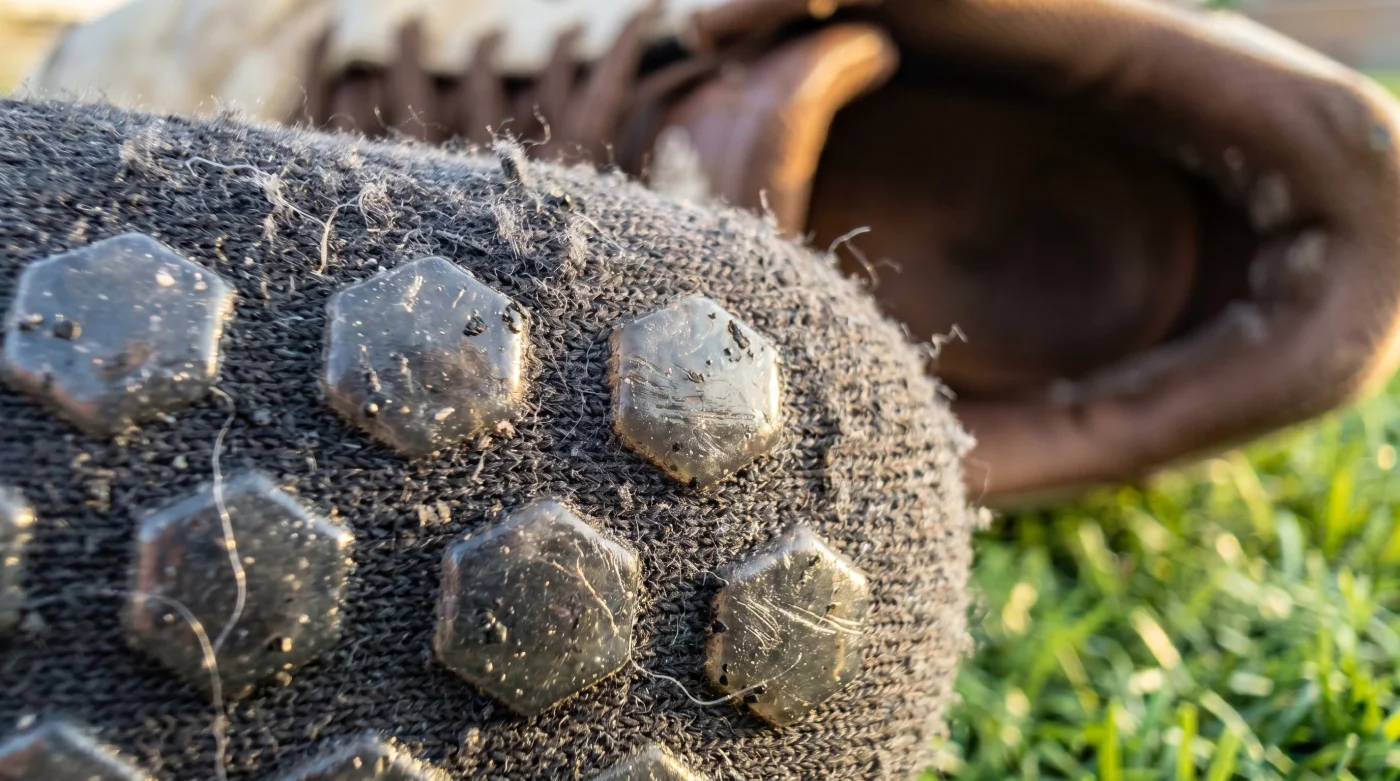
The solution lies in a structural reimagining of what you wear underneath the leather. Silicone traction nodes change everything. By actively gripping both the bare skin of your sole and the synthetic insole of the boot simultaneously, these specialized grips eliminate the energy leak between foot and turf. The sock becomes an unyielding anchor.
Consider the reality of Julian Torres, a 23-year-old reserve midfielder who spent two agonizing seasons watching from the bench. Julian possessed incredible field vision but routinely lost a half-step during rapid defensive transitions. A seasoned athletic trainer sat him down in a locker room smelling of wintergreen rubbing alcohol, analyzed his game tape, and pointed out his false step. Julian was subconsciously curling his toes to find grip inside his slick cotton team socks. The trainer handed him a pair of grip socks. The silicone pads locked his heel firmly into the heel counter, curing his hesitation overnight. He did not magically get faster; he just stopped wasting his own force. Within three weeks, Julian secured a spot in the starting eleven.
Mapping the Advantage Across the Field
Not every player interacts with the turf exactly the same way. The specific angles at which you plant your foot dictate how much friction you require to stay upright. Deliberately understanding your movement profile helps you maximize this physical advantage on the field.
For the Shifty Playmaker: If your game relies heavily on dropping a shoulder and changing direction at full speed, you are constantly fighting massive lateral forces. Grip socks prevent the foot from dangerously rolling over the edge of the soleplate. You can plant with violence and trust the boot will hold your weight.
For the Defensive Anchor: Center-backs and holding midfielders perform a tremendous amount of backpedaling followed by sudden, desperate forward lunges. In this scenario, the friction prevents your toes from aggressively jamming into the front of the toe box. This protects your toenails from deep bruising while maintaining your explosive forward reaction time.
For the Straight-Line Sprinter: Wingbacks and wide midfielders need maximum power transfer for fifty-yard dashes down the touchline. When you strike the ground in a full sprint, the traction nodes ensure that your push-off phase directs 100 percent of your energy backward, propelling you forward without a millimeter of lost momentum.
For the Weekend Warrior: You might not be playing for a lucrative contract, but you are playing for pride on less-than-perfect public pitches. When the ground is uneven, heavily rutted, or slick with morning dew, controlling your internal friction becomes the single variable you can perfectly manage. It turns a sloppy, unpredictable field into a solvable puzzle.
Mindful Application: Locking In the Fit
Transitioning to this high-friction setup requires a slight but deliberate adjustment to your pre-game routine. It is not merely about throwing on new gear; it is about mindfully constructing a secure, customized base for your feet.
Begin by carefully inspecting the insoles of your boots. Wipe away dried dirt or rogue synthetic turf pellets that might interfere with the silicone pads. The surface needs to be relatively clean and dry for the nodes to create their strong mechanical bond.
Next, apply this tactical toolkit for your match-day preparation:
- Trim your team-issued socks right at the ankle with sharp scissors, leaving just the calf tube intact.
- Pull the grip sock on smoothly, ensuring the traction nodes sit completely flat against your heel and the ball of your foot without bunching.
- Slide the team tube over your calf, letting it overlap the top elastic of the grip sock by exactly one inch.
- Wrap the overlapping seam securely with cohesive athletic tape to create a flush transition that will not slide down during a dead sprint.
When you first stand up, the sensation will feel unusually glued to the floor. Walk around the locker room for roughly four minutes to let the natural heat of your foot soften the silicone slightly. This brief warm-up allows the material to subtly mold to the specific arch of your foot before you hit the grass.
The Ground Beneath You
Finding true confidence in your physical movement is rarely about trying harder or pushing through pain. It is usually about systematically removing the subtle, hidden barriers that make your nervous system hesitate. When your foot slides inside your shoe, your brain quietly hits the brakes to protect your joints.
By eliminating that internal slip, you regain absolute trust in your own biomechanics. The ground is no longer an unpredictable surface that you must carefully brace against; it becomes a solid springboard that amplifies your athletic intent.
Eventually, you stop thinking about your feet entirely. And in those chaotic, fast-paced moments when the ball finally arrives at your feet, that beautiful lack of thought is exactly what allows your hard-earned instincts to take over and win the game.
When you eliminate the friction between your skin and the shoe, you stop fighting your own footwear and start attacking the pitch.
| Key Point | Detail | Added Value for the Reader |
|---|---|---|
| Standard Cotton Sock | Smooth, moisture-absorbing fabric that loses structure when wet. | Identifies the root cause of blistering and energy loss during sharp cuts. |
| Grip Sock | Silicone traction nodes placed strategically on the sole and heel. | Locks the foot in place, transferring all physical force directly to the turf. |
| Athletic Tape Wrap | Cohesive bandage applied over the seam of the cut team sock. | Secures the aesthetic match kit without sacrificing the high-performance base. |
Frequently Asked Questions
Do grip socks actually prevent blisters? By stopping the constant rubbing between your heel and the boot, they severely reduce the abrasive friction that causes severe blistering during long matches.
Can I wash them with my regular laundry? Turn them inside out and wash on a cold cycle below 90 degrees Fahrenheit to prevent the high heat from melting or degrading the silicone nodes.
How long do the traction pads typically last? With regular weekly play and proper washing, a high-quality pair will maintain optimal friction for about a full season before the pads wear flat.
Do I need to buy bigger cleats to fit them? No, they are designed to fit seamlessly into true-to-size boots, though they will feel noticeably snugger and more secure during the first wear.
Why do professionals cut their team socks? Organized leagues require matching team colors, so cutting the team sock creates a visual sleeve that satisfies the referee while letting you wear the performance layer hidden underneath.