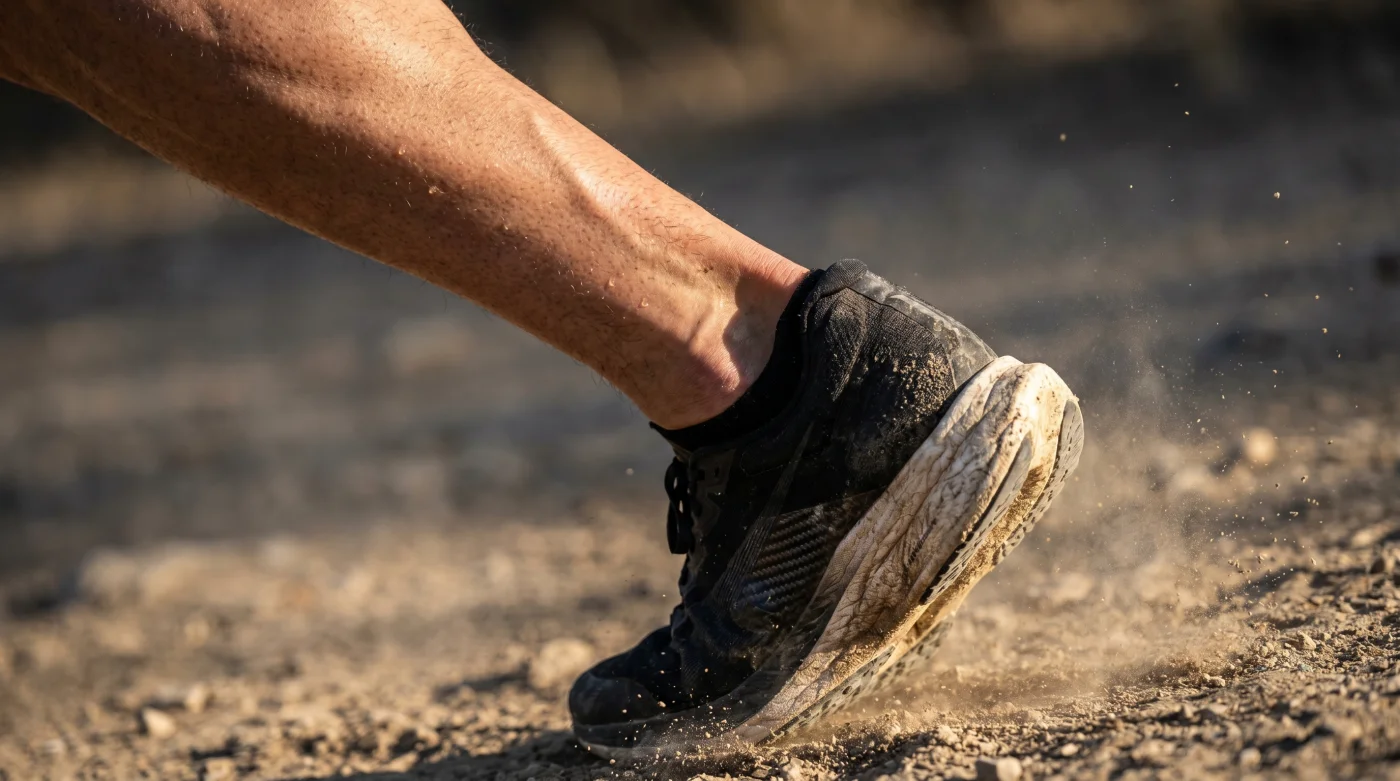
The morning air holds that crisp, metallic bite that makes your lungs burn just a little. You lace up the neon-laced foam blocks you just bought, feeling the stiff, aggressive rocker rolling your weight forward before you even take a step.
These shoes promise an effortless glide, shaving seconds off your pace with space-age materials. But the morning after your long run, a dull, aching tightness in your heel tells a very different story.
You bought them to run faster, assuming the thick foam would absorb the punishment of the pavement. Instead, you are waking up with a stiff lower leg, wondering why the very gear designed to protect you feels like it is quietly tearing you apart.
The reality of professional gear is that it demands professional mechanics. When you slide a rigid sheet of aerospace material under your foot, you change your body’s natural physics, forcing your weakest links to bear the brunt of the speed.
The Lever and the Snap: Reframing the Super-Shoe
A carbon fiber plate is not a trampoline. It is a lever. When your foot strikes the ground, your toes naturally want to bend, absorbing the impact through a complex network of ligaments. The plate stops this bending dead in its tracks.
By keeping your toes perfectly flat and rigid, the shoe acts like a stiff plank. The kinetic energy does not vanish; it simply travels upward, hunting for the nearest hinge, which happens to be your Achilles tendon.
This is the perspective shift that saves your season. The rigidity that gives you that explosive pop off the asphalt is directly transferring sheer force into your lower calf. The shoe is doing exactly what it was built to do, but your tendon is suddenly working overtime to stabilize a lever it was never designed to control.
Recognizing this trade-off turns a hidden danger into a controllable variable. By moderating the drop height of your shoes, you can dictate the sheer force rather than letting the shoe dictate it for you.
The Biomechanist Who Ran Too Fast
Dr. Marcus Thorne, a 41-year-old clinical biomechanist based in Oregon, learned this the hard way. Marcus spent his days analyzing the gait of Olympic hopefuls, but on weekends, he was just another amateur chasing a sub-three-hour marathon. He strapped on a pair of maximum-stack, carbon-plated racers for a twenty-mile training block. At mile sixteen, he felt a sensation like a dry branch snapping behind his ankle. He had focused entirely on the foam’s bounce, ignoring the fact that his aggressive forefoot strike, combined with the stiff midsole, was putting an unprecedented torque on his Achilles. His six-month recovery became a case study in why amateurs cannot simply strap on elite tech without adjusting their structural foundation.
Engineering Your Rotation: Strategies for Every Stride
Not all runners hit the pavement with the same geometry. How that carbon plate interacts with your specific anatomy depends entirely on how your foot finds the ground.
For the Heavy Heel-Striker
If you land hard on your heel, the thick foam compresses deeply before the plate engages. This creates a massive braking force. Your Achilles acts as a shock absorber while the shoe bottoms out, stretching the tendon to its maximum capacity before snapping forward. You need a shoe with a higher drop to take the tension off the calf during that initial impact phase.
For the Aggressive Forefoot Runner
Landing on your toes with a stiff plate means your heel never truly settles. You are essentially running in high heels, forcing the calf muscle to remain contracted. This constant tension leaves the tendon dangerously vulnerable to micro-tears. You require a lower drop shoe to allow the heel to kiss the ground, releasing the pressure valve on the Achilles.
For the Casual Weekend Jogger
If you only run ten or fifteen miles a week, your tendons do not have the structural conditioning of a professional. Wearing carbon plates for every single run is like driving a Formula 1 car to the grocery store. Your muscles never learn to work independently of the rigid lever. Save the super-shoes for race day, and do your daily miles in a flexible, traditional trainer.
The Mindful Application: Tuning Your Lower Leg
Protecting your connective tissue requires a deliberate, minimalist approach. You cannot simply stretch away the damage caused by bad mechanics. You have to build a resilient structural foundation.
Follow this tactical toolkit to safely integrate stiff midsoles into your routine:
- Rotate your footwear: Limit carbon plate usage to no more than twenty percent of your weekly mileage.
- Moderate your drop height: If your daily trainer has an 8mm drop, do not race in a 4mm drop super-shoe without a three-month transition period.
- Perform heavy, slow calf raises: The Achilles tendon responds to slow, heavy loads, not quick, unweighted bouncing.
- Listen to the morning ache: If your heel is stiff when you step out of bed, the tissue is inflamed. This is your warning light to step away from the rigid plates.
The Peace of the Long Road
Chasing speed is a natural instinct, but it should never come at the cost of your mobility. When you understand the mechanical reality of your gear, you stop being a passenger to the marketing hype. You become an active participant in your own physical longevity. The goal is not just to cross the finish line faster, but to walk without pain the morning after.
Mastery over your tools brings a quiet confidence. You can look at the latest foam technologies and rigid carbon curves not as magic bullets, but as highly specific instruments. By respecting the load they place on your calves, and moderating the geometry under your heel, you ensure that your running practice remains a lifelong ritual, rather than a fleeting season of speed followed by months of frustrating rehabilitation.
Speed is borrowed from the stiffness of the shoe, but longevity is earned by the resilience of the tendon.
| Key Point | Detail | Added Value for the Reader |
|---|---|---|
| Carbon Plate Rigidity | Stops natural toe flexion during footstrike. | Identifies why lower leg fatigue happens suddenly with new shoes. |
| Kinetic Transfer | Forces energy past the foot into the Achilles. | Allows you to predict and condition for the specific point of strain. |
| Drop Height Moderation | Matching heel-to-toe drop to your strike type. | Provides a mechanical solution to relieve sheer force on the tendon. |
Frequently Asked Questions
Are carbon plate shoes inherently dangerous for runners? No, they are highly specialized tools. The danger arises when they are used by runners who lack the specific calf and tendon conditioning required to manage the transferred kinetic load.
How can I tell if my Achilles is bearing too much strain? The most reliable indicator is morning stiffness. If your heel feels tight or painful during your first few steps out of bed, your tendon is signaling micro-trauma from the previous day.
Should I buy a shoe with a higher or lower drop? It depends on your mechanics. Heavy heel-strikers benefit from higher drops to prevent over-stretching during foam compression, while forefoot runners may need lower drops to allow the heel to fully rest on the ground.
Can I wear super-shoes for all my daily training? It is highly advised against. Relying daily on a stiff lever prevents your intrinsic foot muscles from working naturally. Keep them for key workouts and race days.
What is the best way to strengthen my calves for these shoes? Incorporate slow, heavily weighted calf raises into your routine. Tendons adapt to heavy, slow resistance much better than fast, light repetition.